Choosing between a WordPress build and a hand-written custom website in India
WordPress vs Custom Website India: The Honest 3-Year Cost
You are holding two quotes. One says ₹18,000 for a WordPress site with a premium theme, live in ten days. The other is several times that for something hand-written. Both PDFs describe "a professional, mobile-friendly, SEO-ready website", so the only thing you can actually compare is the number at the bottom — and the small number obviously wins.
That comparison is the problem. The WordPress vs custom website India decision is almost never decided on the build price, because the cheaper quote is priced as a one-time cost while the thing you are buying behaves like a three-year subscription. Hosting renews at three to four times the promotional rate. Plugin licences bill in dollars from month thirteen, quietly covered by your developer's own agency licence in year one. An annual maintenance contract (AMC) is not mentioned until something breaks.
This post gives you the column nobody puts on the quote: a three-year rupee table, measured performance numbers from published benchmarks with named sources, and a straight, specific list of the situations where WordPress is the correct and cheaper answer — because several of them are real.
WordPress vs Custom Website India: A Decision Framework, Before Any History
Skip the CMS history lesson. Here is the decision, compressed.
| Your situation | The right build |
|---|---|
| You publish articles, notices or news weekly | WordPress |
| Non-technical staff edit page content most days | WordPress |
| You need to be live in a week | WordPress |
| A conventional blog, or a standard WooCommerce catalogue | WordPress |
| You want one-time licensing instead of annual renewals (Divi's lifetime option) | WordPress |
| The site is mostly fixed pages plus one thing you update (rates, products, stock) | Custom |
| Speed on a mid-range Android is a revenue issue | Custom |
| The site must talk to your ERP, Tally, dealer portal or an internal panel | Custom |
| You cannot afford an unplanned outage caused by someone else's update | Custom |
| You want the code, with no third-party subscription keeping it online | Custom |
Most businesses fall cleanly on one side. If you fall on the WordPress side, stop reading agency blog posts — including this one — and get a well-hosted, hardened WordPress build. If you fall on the custom side, the rest of this post is the evidence for why.
And a fairness anchor before anything else: WordPress powers 40.2% of all websites and 58.8% of every site running a known CMS, according to W3Techs as of 16 September 2026. Its gentle slide from a roughly 43.6% peak in mid-2025 is a trend note, not an obituary. Anyone telling you WordPress is dying is selling something.
Is a WordPress Website Cheaper Than a Custom Website in India? The Three-Year Table
Usually yes in year one. Often no by year three. The line items below are the ones missing from the ₹10,000–25,000 quote.
| Cost line | Year 1 | Years 2–3 | Source |
|---|---|---|---|
| Build | ₹10,000–25,000 | — | Your quote |
| Shared hosting | ₹69–249/mo promo | ₹289–649/mo on renewal | Hostinger India, Sep 2026 |
| Caching plugin (WP Rocket) | Often covered by the developer | $59.95/yr per site | WP Rocket, first-party |
| Page builder (Elementor Pro / Divi) | Usually the agency's licence | from around $59/yr, or Divi $89/yr | Vendor pages, secondary |
| Security platform (Sucuri) | Rarely bought upfront | $229–$549/yr | Sucuri, first-party |
| AMC | Sometimes free for 3 months | ₹18,000–36,000/yr basic; ₹36,000–84,000 standard | Indian agency price lists |
| Malware cleanup, if it happens | — | $300–$1,800, or $179–$249 one-time tools | Secondary |
Three caveats, stated plainly. Hostinger's promo rates require 48 months paid upfront — the cliff lands inside your three-year window either way. The AMC ranges come from Indian agencies that sell AMC (upGrowth, RedPulse, Aarav Infotech) and they disagree with each other; a competing list quotes ₹15,000–30,000/yr, so treat these as market-indicative, not authoritative. And the dollar-billed licences are invisible in year one precisely because your developer's multi-site licence covered your build, not because they are free.
Roughly ₹5,000–₹12,000 a year in recurring foreign-currency fees, plus an AMC, plus a hosting renewal at 3–4x. That is the column that changes the decision. For a full breakdown of what a site should actually cost to commission in India, we wrote a separate piece on what a website really costs in India — this post is about how the thing is built, not what to pay for it.
When WordPress Is Genuinely the Better Choice — Specifically, Not as a Hedge
Every agency blog on page one for this query concedes WordPress is "good for startups who want something fast and cheap" and then spends 2,000 words undoing it. Here is the honest version.
Choose WordPress, without hesitation, if:
- You publish weekly. A school posting circulars, a clinic posting health articles, a trade association posting notices. WordPress's editorial workflow — drafts, scheduling, revisions, categories, authors — took twenty years to get right. Rebuilding that in a custom admin panel is money set on fire.
- Non-technical staff edit pages daily. If your office manager restructures pages, swaps hero images and adds sections without calling anyone, a block editor is the product you want. A custom site gives you a panel for the fields you defined; it does not give you free-form page design.
- You need to be live next week. Two to three weeks is a realistic hand-written timeline. If a tender deadline or an exhibition is in nine days, a good theme configured properly is the correct decision.
- You need a conventional online store. Standard catalogue, standard cart, standard Razorpay checkout — WooCommerce plus a payment plugin is thousands of hours of solved problems. Custom is justified when your pricing logic is odd (dealer-specific slabs, GST-inclusive quoting, MOQ rules), not because custom is nicer.
- You want to stop renewing licences. Divi's one-time lifetime licence (around $249) genuinely breaks the annual-renewal pattern described above. If the recurring-fee argument is what worries you, that option answers it.
A well-hosted, hardened WordPress build in those cases is cheaper, faster to ship and easier to live with. Saying so is the only reason to trust the paragraphs where we don't.
Why Is My WordPress Site Slow on Mobile but Fast on Desktop?
Because your desktop is not your customer. 64.45% of Indian page views came from mobile in August 2026, against 34.97% desktop (StatCounter, share of page views across 1M+ tracked sites). And the handsets are Vivo 17.67%, Xiaomi 15.54%, Realme 12.54%, Samsung 11.86%, Oppo 10.96%, Motorola 9.36% — Apple is not in the top six. Your visitor is on a mid-range Android, not the flagship the theme was demoed on.
The constraint is not an ancient OS — Android versions in India are reasonably current, with 16.0 at 24.11% and 15.0 at 23.28%. The constraint is mid-range CPU and thermal throttling meeting a page built for a laptop.
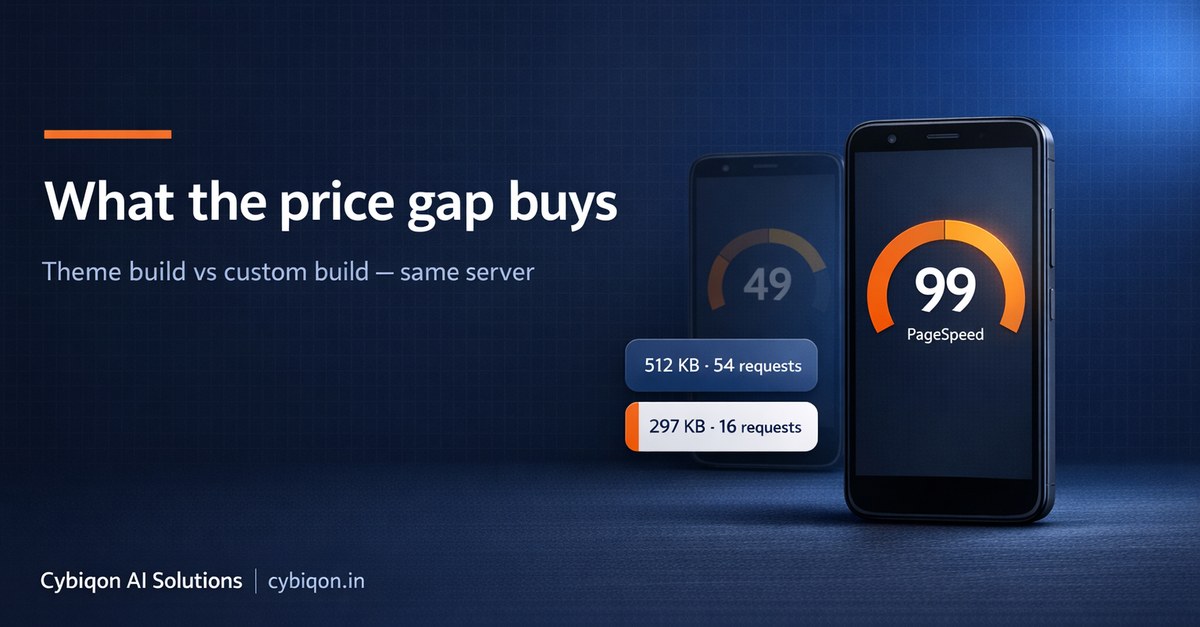
The cleanest evidence is a published controlled test by WP Bullet, not a before-and-after from an agency selling rebuilds. A live Elementor Pro site on a 1GB VPS — nginx and PHP, no CDN, no page caching — served a homepage of hero, four images and a three-column grid as:
- 512 KB across 54 HTTP requests, 172ms TTFB, 1,400ms first paint, PageSpeed 49 (its landing page scored 29)
The same content and design intent, rebuilt on lightweight blocks on the identical server with zero infrastructure change:
- 331 KB / 34 requests, 85ms TTFB, 499ms first paint, PageSpeed 88
- With straightforward optimisation on top: 297 KB / 16 requests, 300ms first paint, PageSpeed 99; the landing page went from 29 to 95–99
Nothing was bought and nothing was moved. Page weight nearly halved and requests fell by two-thirds purely by removing the page builder's overhead. For context, the median web page in 2025 shipped 2,164 KB on mobile with 646 KB of JavaScript (HTTP Archive Web Almanac 2025). Google's "good" threshold for Interaction to Next Paint is ≤200ms at the 75th percentile of real field visits — worth knowing, though responsiveness is the Core Web Vital most sites already pass. On Indian mobile, the fight is page weight and how fast the largest element paints.
What Happens When a WordPress Plugin Update Breaks My Site?
This is the question to ask the person quoting you, and the answer determines everything.
Patchstack's State of WordPress Security in 2026 counted 11,334 new vulnerabilities across the WordPress ecosystem in 2025 — up 42% year on year. 91% were in plugins, 9% in themes, and only 6 were in WordPress core, all low-priority. Read that distribution carefully: the risk in a WordPress build is almost never WordPress. It is the third-party plugin stack bolted on top of it. Patchstack also found 46% were not fixed in time for public disclosure.
Then the number that reprices every maintenance contract in India: the median time to first mass exploitation of a high-impact WordPress vulnerability is five hours. 20% are exploited within six hours, 45% within 24 hours, 70% within seven days. A quarterly "we'll update the plugins" AMC is not slow — it is structurally the wrong cadence. If you are staying on WordPress, that fact is the honest argument for managed hosting with virtual patching, not for a cheaper AMC.
Two more things worth knowing:
- 45.6% of the 57,383 plugins in the WordPress.org directory had shipped no update in 24 months or more, per a June 2026 analysis by wpgoldmine.io published via DEV Community. Well-sourced, not peer-reviewed — but it means a plausible half of what is available has no active maintainer.
- You can lose control of a dependency without doing anything. In October 2024, Advanced Custom Fields — installed on more than 2 million sites — was forked to Secure Custom Fields inside the official repository, with no action by site owners (Dark Reading).
And the strongest evidence is from WordPress itself, not from a company selling custom development. WordPress 7.1 "Mary Lou" shipped on 19 August 2026 without its planned React 18-to-19 upgrade, which core pulled after finding it broke how plugins consume React. React 19 now sits behind an experimental flag in Gutenberg 23.4+. Since ReactDOM.render(), findDOMNode(), string refs and defaultProps for function components are removed or deprecated in React 19, that breakage is deferred, not cancelled. WordPress core documented, in public, that its own plugin ecosystem was too fragile to upgrade a dependency.
If your site does go down or gets flagged, we have a separate walkthrough on getting the "this site may be hacked" warning removed.
Are Premium WordPress Themes from ThemeForest Safe? And What Is a Nulled Theme?
"Premium" is a price signal, not a safety signal. Patchstack's 2026 data found 76% of vulnerabilities in premium WordPress components were exploitable, and premium components carried three times more known-exploited vulnerabilities than free ones. Paying for a theme buys support and design, not immunity.
A nulled theme is a pirated copy of a paid theme or plugin, with the licence check stripped out and redistributed free. This matters specifically in the ₹10,000–25,000 bracket, where a line item reading "premium theme worth ₹8,000" is sometimes a nulled download, and the saving goes to the person writing the quote rather than to you.
They almost always ship a backdoor. The wp-vcd malware family, documented by Patchstack, silently creates a hidden admin user so the attacker keeps access after any cleanup. Wordfence traced malware to nulled plugins and themes on 206,000 sites — over 17% of all infected sites it cleaned — in its 2020 data, the most recent named figure of its kind. It is five-year-old data and should be read as an order of magnitude, not a current rate.
Two questions to put in writing before you sign: which theme and which plugins, by name and version? and whose licence key are they registered under? If the answer to the second is the agency's, you now know what renews in month thirteen.
Do I Own the Code, and Can I Edit a Custom Site Without a Developer?
On WordPress, the software is GPL and yours to run — but that is not the same as owning your site. Ownership in practice is four things: the domain registrar account, the hosting account, the database, and the licence keys. If the premium theme is registered to your developer, you cannot get updates without them. This is the scenario behind our guide on what to do when your developer will not hand over website access — and it is worth resolving on day one rather than in a crisis.
Ask for, in writing, before payment: registrar login, hosting and DNS credentials, the database, an admin account you control, a copy of the source, and a list of every paid component with its licence holder named.
Can you edit a custom-coded site yourself? Yes — if an admin panel was built for the fields you actually change. That is the honest trade. WordPress gives you free-form editing of everything, and the overhead that comes with it. A custom site gives you a small panel that does exactly your job — update a price list, add a product, change a rate card, publish a notice — and nothing you can accidentally break. If your editing needs are broad and daily, WordPress wins that trade. If they are narrow and specific, the panel wins.
Whichever you choose, the same fundamentals decide whether anyone finds the site: the technical basics behind showing up when someone searches for your business locally matter far more than the platform, and a lapsed certificate will undo both — which is why SSL renewal deserves a calendar reminder.
FAQs
Is a WordPress website cheaper than a custom website in India?
In year one, almost always. Across three years, frequently not. Add the hosting renewal (Hostinger India moves from ₹69–249/mo promo to ₹289–649/mo, with promo rates requiring 48 months upfront), roughly ₹5,000–₹12,000/yr in dollar-billed plugin licences, and an AMC that Indian agencies price from about ₹18,000/yr basic. Build the three-year total for both quotes before comparing.
Why is my WordPress site slow on mobile but fast on desktop?
Because 64.45% of Indian page views are mobile (StatCounter, August 2026) on mid-range Vivo, Xiaomi and Realme handsets that throttle under load, while your desktop does not. A page builder is usually the cause: in WP Bullet's controlled test, moving the same design off Elementor Pro on the identical server took a homepage from 512 KB / 54 requests / PageSpeed 49 to 331 KB / 34 requests / PageSpeed 88.
How often does a WordPress website need maintenance?
More often than most contracts assume. The median time from disclosure to first mass exploitation of a high-impact WordPress vulnerability is five hours, with 45% exploited inside 24 hours (Patchstack, 2026). Monthly patching is late; quarterly is decorative. Managed hosting with virtual patching is the realistic answer if you stay on WordPress.
When is WordPress the better choice over a custom website?
When you publish content weekly, when non-technical staff edit pages daily, when you must be live in a week, when you need a conventional blog or a standard WooCommerce store, or when you specifically want one-time licensing such as Divi's lifetime option. In those cases a hardened, well-hosted WordPress build is the cheaper and correct decision.
Do I have to keep paying for Elementor Pro every year?
On a page-builder site, yes, unless a one-time licence is chosen. Elementor Pro runs from around $59/yr and Divi is $89/yr or roughly $249 one-time (vendor pricing, secondary sources); WP Rocket is $59.95/yr for a single site. Year one often looks free because the developer's own agency licence covered the build.
What Cybiqon Would Build Instead
If the WordPress vs custom website India choice lands on the custom side for you, here is what that looks like with us. We hand-write the site — no page builder shipping features you never asked for to a customer's mid-range Android — and we build a small admin panel scoped to exactly what you actually change: the price list, the product range, the rate card, the notices. Nothing more, so there is nothing to break.
You get the source code, the repository, the domain and the server credentials on handover. No third-party licence renews in dollars behind your back, and the three-year cost is legible on day one instead of arriving in month fourteen.
If that is the version you want, our custom website development page sets out what ships. Or book a 30-minute call at tidycal.com/itspyguru/cybiqon-30-minute-meeting, call +91 9250711473, or write to [email protected] — bring both quotes and we will tell you honestly if WordPress is the better buy.
The Takeaway
The WordPress vs custom website India question has no universal answer, and anyone giving you one is selling. If you publish weekly, need daily page edits, or need to launch in a week, WordPress is right and hardening it is the job. If your site is mostly fixed pages plus one thing you update, speed on a mid-range phone matters, and you want the code, custom is right. Either way, build the three-year column — hosting renewal, dollar licences, AMC — before you sign. The cheaper quote is rarely the cheaper website.
Want this set up for your business?
Book a free call — no tech jargon, no sales pressure. Just honest answers.