stopping unauthorised sellers of a brand's products on Amazon and Flipkart in India
Unauthorised Sellers on Amazon and Flipkart: What You Can Stop
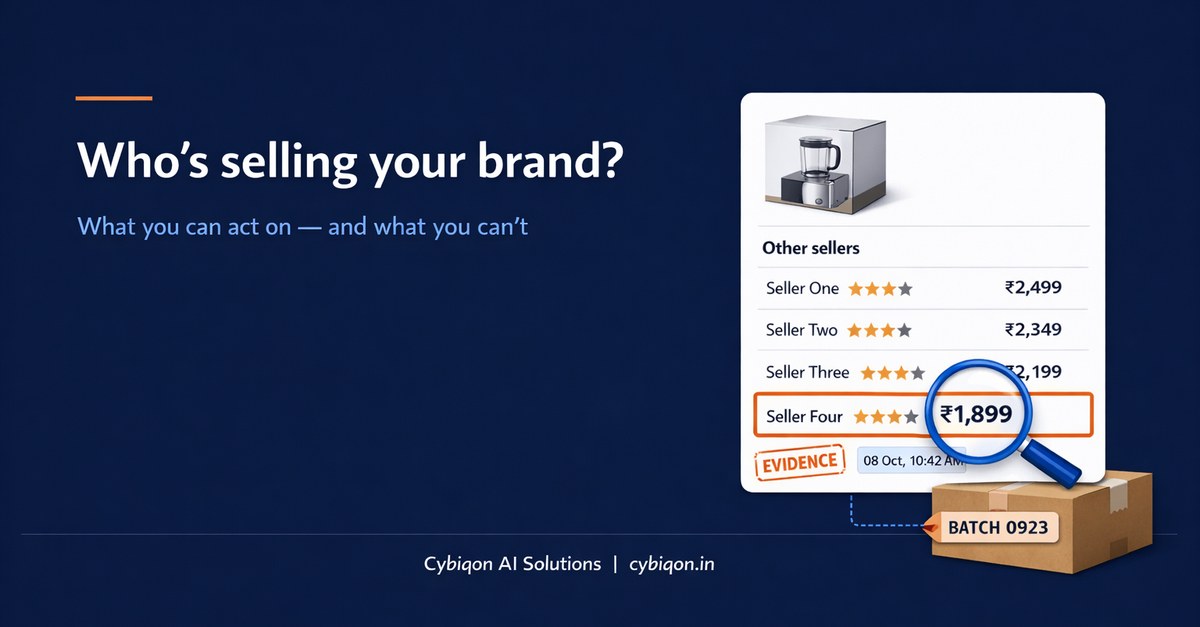
Every festive season your dealers forward you the same screenshot: your product on Amazon or Flipkart, sold by a seller nobody in your sales team has heard of, below the price your dealer pays you. If you are searching for how to stop unauthorised sellers on Amazon and Flipkart, the honest answer starts with an uncomfortable fact. Indian trade mark law generally lets anyone resell genuine goods they have bought, so "not one of my distributors" is not, by itself, a reason for either platform or a court to take a listing down.
What you can act on is narrower, and more useful than it sounds: fakes, tampered or effaced codes, sales above MRP, listings that pass themselves off as you, and some imports. The obvious reaction, fining the dealers who discount, is the pattern the Competition Commission of India (CCI) fined Maruti Suzuki ₹200 crore for (that penalty has been stayed on appeal).
With Amazon's Great Indian Festival starting on 8 Oct 2026 and Flipkart's Big Billion Days on 9 Oct, this guide covers the free platform tools, the listings you can act on, the competition-law trap, tracing leaked stock, and a responsible evidence log. It is not legal advice.
Can You Stop Unauthorised Sellers on Amazon and Flipkart in India?
Usually not for being unauthorised alone. Section 30(3) of the Trade Marks Act, 1999 says that once genuine goods are lawfully put on the market, reselling them does not infringe the trade mark. The courts have read this broadly:
- Kapil Wadhwa v Samsung (Delhi High Court division bench, 3 Oct 2012) accepted international exhaustion. Parallel imports of genuine Samsung printers were allowed, provided the seller disclosed that no Samsung warranty applied.
- Amazon Seller Services v Amway and Modicare (Delhi High Court division bench, 31 Jan 2020) held that exhaustion is general, not limited to direct selling. A brand claiming the goods were altered needs concrete evidence of it. And contractual restrictions bind the brand's own distributors, not the marketplace.
One caveat: Amway was an interim-injunction ruling, and on 14 Dec 2021 the Supreme Court said its observations should not affect the trial.
So ask "which listings can I prove are not genuine resale?", not "how do I remove everyone outside my network?". Fakes are common. According to the ASPA-CRISIL State of Counterfeiting in India 2025 report, released in March 2026, 89% of the 1,639 consumers surveyed across nine cities had bought a counterfeit at least once, and 35% had come across fakes in the previous 12 months.
And Amazon India alone has more than 20 lakh sellers, 3 lakh of whom joined in the past year (About Amazon India, September 2026). Checking by hand does not keep up.
What Amazon Brand Registry and Flipkart Brand Assure Give You Free
Before you pay anyone, use the tools the platforms already give trade mark owners:
| Tool | Cost | What it does | Where it stops |
|---|---|---|---|
| Amazon Brand Registry | Free, with a registered or pending Indian trade mark | Brand dashboard, Report a Violation for IP infringement | Acts on infringement, not on genuine resale |
| Amazon Project Zero | Free, self-service | Lets you remove counterfeit listings yourself | Needs Brand Registry and a 90%+ acceptance rate on your past reports |
| Amazon Transparency | Paid | Unit-level serial codes checked before shipping | Costs money and needs codes printed on every unit |
| Amazon SP-API (getItemOffers) | Free with a seller account | Official list of the offers on each ASIN | Only data. It removes nothing |
| Flipkart Brand Assure (brandhub.flipkart.com) | Free for trade mark owners | Report Violations; Manage Sellers to mark sellers unauthorised | Flipkart reviews each mark, and removal is its decision |
Flipkart also takes infringement complaints at [email protected].
Look at the last column. All of these tools act on counterfeits and IP infringement. Marking a seller "unauthorised" on Brand Assure asks Flipkart to review them; it does not guarantee removal of someone selling your genuine stock. Only Amazon, Flipkart or a court decides that.
One step removes nothing but still helps. In September 2025, Samsung India published its official Amazon and Flipkart seller lists, citing activated, used, refurbished and counterfeit phones sold as new. It is a disclosure, not a takedown.
Unauthorised Sellers on Amazon and Flipkart: The Listings You Can Act On
Here is where the law does give you grounds.
- Counterfeits. The resale exception does not protect fakes. Report them through Brand Registry, Project Zero or Brand Assure, with test-buy evidence.
- Tampered, effaced or altered goods. Section 30(4) removes the resale protection when goods have been changed or impaired. In Western Digital v Geonix (Delhi High Court, 9 Mar 2026), the court treated effacing marks as impairment, while allowing refurbished goods to be sold with clear disclosure. Scratched-off batch codes and missing serials count, but you need concrete proof.
- Selling above MRP. Rule 18(2) of the Legal Metrology (Packaged Commodities) Rules, 2011 bars selling a packaged commodity above its retail sale price. Report it to your state Legal Metrology department or the National Consumer Helpline. Penalties changed under the Jan Vishwas (Amendment of Provisions) Act, 2026 (Legal Metrology provisions in force from 1 May 2026), so check the current position.
- Passing off and "latching on". In Piyush Sapra v Flipkart (the Shapermen case, Delhi High Court, June 2026), Justice Tejas Karia found a prima facie case of passing off through Flipkart's "latching on" feature. He ordered Flipkart to delist further reported listings within 72 hours of notice and to disclose seller details within 7 days. The court acted on passing off, not on the sellers being unauthorised.
- Imports carrying your Indian-registered mark. Products and Ideas v Nilkamal (Delhi High Court division bench, 23 Mar 2026) held that exhaustion covers only goods put on the market by, or with the consent of, the Indian registered proprietor, so such imports can infringe.
How to find a seller's name and address
Rule 5(3)(a) of the Consumer Protection (E-Commerce) Rules, 2020 requires a marketplace to display each seller's business name, whether it is registered, its geographic address, a customer-care number and its rating. Record them the day you see the listing; sellers change names.
Resale Price Maintenance in India: The CCI Trap Brands Walk Into
Resale price maintenance (RPM) means a supplier controlling the price a reseller charges. When dealers complain about discounting, the easy answer is to police prices and punish whoever cuts them. The CCI has fined that exact pattern twice:
- Hyundai Motor India: ₹87 crore (June 2017). Mystery shoppers posing as customers checked dealer discounts, and dealers were fined from ₹2 lakh for a first violation up to ₹80 lakh for a sixth.
- Maruti Suzuki: ₹200 crore (order dated 23 Aug 2021). A "Discount Control Policy" was enforced through mystery-shopping agencies, with penalties on dealers and their staff and supply suspended. NCLAT stayed the penalty on 22 Nov 2021, subject to a 10% deposit. Maruti's appeal was still being heard at NCLAT as of its last disclosed hearing in late May 2026, and the penalty has been stayed since November 2021.
The Competition (Amendment) Act, 2023 widened RPM to cover "any direct or indirect restriction", including on services. It also made settlements and commitments available in vertical cases like these.
Two cases show where the line sits:
- Kaff Appliances. Snapdeal complained (Case 61 of 2014) after Kaff posted a notice that Snapdeal sold its products unauthorised and warranties would not be honoured. The CCI dismissed it on 15 Jan 2019: no RPM was found, distributors confirmed Kaff did not dictate prices, and the notice read as a genuine counterfeit concern.
- Ashish Ahuja v Snapdeal and SanDisk (CCI, 19 May 2014). Keeping a list of authorised online sellers was not held anti-competitive.
In practice: set objective, quality-based criteria for who counts as authorised (storage, warranty handling, genuine invoices) rather than a blanket ban on selling online. Watching the market is not the offence. Using what you see to fine discounting dealers is. Take legal advice on your distributor contracts before you change them.
How to Trace Leaked Stock to a Distributor With Batch Codes
When the stock is genuine, ask where it came from. Your leverage is the distributor contract, on terms other than price.
Say an appliance brand in Rajkot bills 40 distributors, and a mixer-grinder turns up on Flipkart from a seller in Delhi that nobody recognises. If every carton's batch or serial number was recorded against the invoice it shipped on, one test purchase answers the question:
- Record codes at dispatch. Every batch or serial range goes against the distributor invoice it shipped on.
- Test-buy the suspect listing. Photograph the carton, batch code and MRP, and keep the order invoice.
- Match the code to the invoice to see which distributor it was billed to, and when.
- Check the condition. An effaced code is not a dead end; under s.30(4) it may be your strongest evidence.
- Talk to the distributor about your agreed terms, such as territory, storage or warranty handling, and not about the price they sold at.
A B2B ordering app for distributors is the natural place to record batch codes against invoices; a dispatch register works too, if someone keeps it up.
Building a Marketplace Seller Price Monitoring Tool, Responsibly
To act, you need proof of which seller listed what, at what price and MRP, in what condition, on which date. A marketplace seller price monitoring tool collects that without someone screenshotting every evening. Build it in this order:
- Official data first. Use the Brand Registry and Brand Assure views, and Amazon SP-API offers per ASIN where your seller account allows it.
- Public pages second. Make light, rate-limited checks of public, logged-out listing pages, and back off when you are blocked or sent a notice. Amazon's Conditions of Use exclude robots and data-extraction tools, so scraping carries a terms-of-service risk even where it is not a crime. Under the IT Act, s.43 creates civil liability for access without permission, and s.66 needs dishonest intent. We cover the detail in whether web scraping is legal in India.
- Store only what the complaint needs. Keep business and seller details, and nothing more. A sole proprietor's name and address can be personal data under the DPDP Act, 2023.
Each log entry holds a timestamp, marketplace, listing ID, the r.5(3)(a) seller details, price, displayed MRP, condition, a screenshot and, after a test buy, the batch code. It is the same price and competitor monitoring with web scraping that businesses already use for market research, pointed at your own catalogue.
When you don't need to build anything: if you have a dozen SKUs on one marketplace, the free dashboards, a shared sheet and a weekly check will do. The step up is a custom Chrome extension that saves the listing details and screenshot in one click while your team browses. A scheduled monitor only pays off with hundreds of SKUs, several marketplaces, or a festive week when listings change by the hour.
Festive Season 2026: What to Do Before 7 October
| Date | Event |
|---|---|
| 21 Sep 2026 | Amazon announces the Great Indian Festival 2026 |
| 7 Oct 2026 | Prime early access, reported as a 24-hour window |
| 8 Oct 2026 | Amazon Great Indian Festival starts; Flipkart early access for Plus, Black and Flipkart credit-card members |
| 9 Oct 2026 | Flipkart Big Billion Days main sale starts |
Before 7 Oct:
- Get your trade mark filings into Brand Registry and Brand Assure. Brand Registry accepts a pending Indian trade mark.
- Publish an authorised-seller page on your website, as Samsung India did, and make sure your real dealers are easy to find. That is the same work as showing up on Google when customers search near you.
- Baseline every seller and price on your top 20 SKUs now.
- Tell your dealers you are logging counterfeits, tampering and above-MRP listings, not policing their prices.
If the same people also run a lookalike website, stopping fake domains that use your company name is a separate process worth starting the same week.
FAQs
Is it legal to resell a brand's products online without authorisation in India?
Generally yes, for genuine goods: s.30(3) of the Trade Marks Act protects resale after the first lawful sale. It does not protect counterfeits, changed or impaired goods (s.30(4)), passing off, or selling above MRP.
Can a brand stop its distributors selling online or below a price in India?
Controlling resale prices risks CCI action for resale price maintenance, as with Hyundai (₹87 crore) and Maruti (₹200 crore, stayed). Objective, quality-based authorisation criteria are safer than a blanket online ban. Take legal advice on your contracts.
Is selling above MRP on Amazon/Flipkart illegal and how do I report it?
Yes. Rule 18(2) of the Legal Metrology (Packaged Commodities) Rules, 2011 bars selling a packaged commodity above its retail sale price. Report it to your state Legal Metrology department or the National Consumer Helpline, with a screenshot showing the listing price and MRP.
How do I find a seller's name and address on Amazon/Flipkart?
Under Rule 5(3)(a) of the Consumer Protection (E-Commerce) Rules, 2020, the marketplace must show each seller's business name, registration status, address, customer-care number and rating. It is usually on the seller's profile page. Save it with a date.
Is it legal to scrape Amazon and Flipkart prices to monitor sellers?
It is a grey area, not an automatic crime. Use official data such as the SP-API first, keep checks of public logged-out pages slow, and stop when blocked. Amazon's Conditions of Use exclude data-extraction tools, which is a terms-of-service risk.
How Cybiqon Can Help
If your dealers already send you screenshots, what's missing is an evidence log, not another subscription. Cybiqon builds seller-and-price monitoring for brands. It pulls official marketplace data first, runs light checks of public listings, keeps a timestamped log of every seller, price, MRP and change, and matches batch codes from test buys to your distributor invoices. It is written around your SKUs and your distributor network, not configured from a template, and your team owns the code and the data.
Email [email protected], or DM us, with one product and the two or three marketplaces it leaks onto, and we'll scope it. You can also book a 30-minute call or ring +91 9250711473. Amazon, Flipkart and the courts decide what comes down. The log gives them evidence to decide on.
Conclusion
You cannot remove unauthorised sellers on Amazon and Flipkart just for being outside your network. Genuine resale is generally lawful, and pressuring discounting dealers is the pattern the CCI has fined. You can act on counterfeits, tampered codes, above-MRP pricing, passing off and some imports, and batch codes show which distributor the stock came from. Start with the free platform tools, keep a dated evidence log, and take legal advice before changing distributor contracts. Do it before 7 Oct 2026. If you want the log built, Cybiqon can help.
Want this set up for your business?
Book a free call — no tech jargon, no sales pressure. Just honest answers.