job work management software and ITC-04 register for manufacturers
Job Work Management Software: ITC-04, Challans and a Register
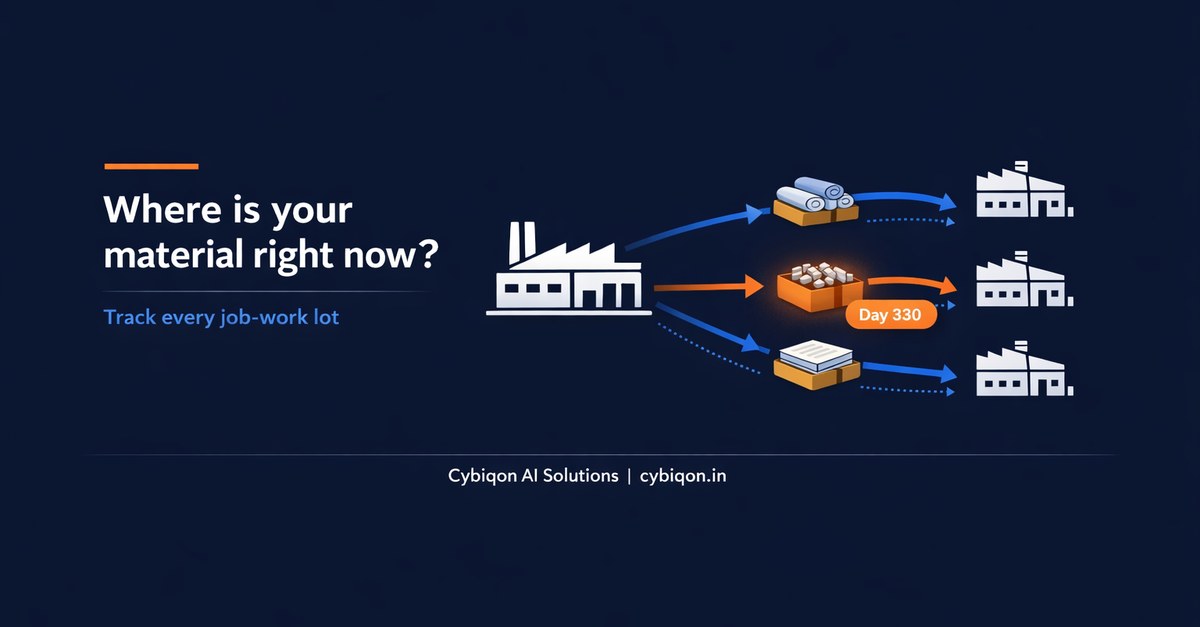
Say you run a Ludhiana hosiery unit or a Pune machining shop, and someone asks what is lying with your job workers today. The answer probably starts with "let me check the challan book." Cut panels are at three stitching units, shafts are at the plating shop, and some lots have moved on to a second job worker on a hand-written endorsement. Closing that gap is the whole job of job work management software.
It matters more this month. If your aggregate turnover in FY 2025-26 was above ₹5 crore, your ITC-04 for April–September 2026 is due on 25 October 2026. And in June 2026 the Madras High Court upheld a Section 74 proceeding against a Coimbatore foundry that could not show its job-work inputs had come back in time.
This guide covers the ITC-04 due date as the law now stands, what happens at the one-year line, what a challan must carry, a column-by-column job work register format mapped to ITC-04's tables, and whether TallyPrime is already enough.
This is general information. Confirm the specifics with your CA. Cybiqon doesn't sell GST filing or tax advice, only the register software.
What job work management software does (and why it isn't "job management software")
Search for "job management software" and you get American tools that schedule plumbers. Job work in the GST sense is something else. Under Section 143 of the CGST Act, a registered principal can send inputs or capital goods to a job worker for processing (stitching, plating, machining, printing) without paying tax on that movement. The condition is that the goods come back, or are supplied onward, within set time limits.
So job work software has to answer four questions at any moment:
- What is out, and with whom? Stock with each job worker, by lot.
- Since when? Days out against the one-year or three-year line.
- What came back? Part returns, scrap and wastage.
- Where did it go next? A second job worker, or your customer.
Then it has to hand you ITC-04 data without anyone rebuilding six months of challans the week before the due date.
A challan book records what went out. An Excel sheet records returns if someone types them. Neither ties a return back to its lot, and that is where tracking material sent to job workers falls apart. It is one of the signs your business has outgrown Excel, though, as you'll see below, the fix isn't always new software.
ITC-04 due date 2026: half-yearly or annual?
Several pages that rank for this still say ITC-04 is quarterly. It hasn't been quarterly since 1 October 2021. Rule 45(3) of the CGST Rules, as substituted by Notification 35/2021-Central Tax dated 24.09.2021, sets the frequency by the principal's aggregate turnover in the preceding financial year:
| Aggregate turnover in preceding FY | Frequency | Period | ITC-04 due date |
|---|---|---|---|
| Above ₹5 crore | Half-yearly | April–September 2026 | 25 October 2026 |
| Above ₹5 crore | Half-yearly | October 2026–March 2027 | 25 April 2027 |
| Up to ₹5 crore | Annual | FY 2026-27 | 25 April 2027 |
The test uses last year's turnover (FY 2025-26 for this year's returns), not this year's. We found no change to the rule in 2025 or 2026. Note that 25 October 2026 is a Sunday. Don't count on an extension; file before the weekend.
How it's filed. The GST portal's ITC-04 manual describes the process. You fill the offline Excel tool (the "ITC-04 Excel format" people search for), generate a JSON file, upload it and file with a DSC or EVC. The return has four tables you need to know:
- Table 4: goods sent to a job worker
- Table 5A: goods received back from a job worker
- Table 5B: goods sent from one job worker to another
- Table 5C: goods supplied from the job worker's premises
The tool is the easy part. The hard part is clean data for Tables 5A–5C, which lives in return challans, endorsements and phone calls.
Section 143 job work time limit: what if goods don't come back?
Section 143(1) gives one year for inputs and three years for capital goods from the day they were sent out. On sufficient cause, the Commissioner can extend these by up to one and two more years respectively. Moulds and dies, jigs and fixtures, and tools are excluded from the return deadline.
If inputs or capital goods aren't returned, or supplied from the job worker's premises, within the limit, Sections 143(3) and (4) treat them as supplied by you on the day they were sent out. Rule 45(4) and CBIC Circular 38/12/2018-GST (26 March 2018) then require you to:
- invoice it in the month the limit expires, and declare it in GSTR-1
- pay tax on it, plus interest under Section 50 at 18% per annum from the date the goods were sent out, not from the date you noticed
Illustratively: a lot of steel blanks that left your gate on 10 October 2025 and is still at the plating shop on 10 October 2026 becomes a supply dated 10 October 2025, with a year of interest on top.
The 2026 case worth reading. In Tvl. Technocast Foundry v. State Tax Officer, Coimbatore (2026-VIL-582-MAD, June 2026), Justice C. Saravanan of the Madras High Court heard a company that had sent inputs to a sister concern, Unitech Couplers India Pvt Ltd, for job work. It couldn't show they came back within the Section 143 limits, and hadn't filed ITC-04, reportedly because it couldn't be uploaded due to technical issues. The court upheld the use of Section 74 and sent the matter back, giving the company 30 days to prove revenue neutrality. TaxGuru reports demands of approximately ₹21.9 crore, ₹19.7 crore and ₹12.7 crore for 2018-19 to 2020-21, plus interest and penalty. The outcome is still open. The lesson is that even with a sister concern, the argument came down to records.
Job work challan format under GST: what Rule 55 requires
The law prescribes what a job-work delivery challan contains, not how it looks. Under Rule 55(2) of the CGST Rules:
- date and number of the challan
- consignor's name, address and GSTIN
- consignee's name, address and GSTIN (if registered)
- HSN code and description of the goods
- quantity
- taxable value
- tax rate and tax amount, where the transport is for a supply to the consignee
- place of supply, if the movement is inter-state
- signature
Circular 38/12/2018 adds three practical points:
- The challan is issued in triplicate.
- Goods can move from one job worker to another by endorsement on the challan or on a fresh challan.
- Inter-state movement of goods for job work needs an e-way bill whatever the value. For intra-state movement, check your state's e-way bill rules with your CA.
A printed challan book gets these fields right. The trouble starts afterwards: goods come back on the job worker's own challan, and the only link to yours is a number someone may or may not write down.
Job work register format: the columns any job work management software needs
Search "job work register format" and most results are labour-law registers for contract workers. A job-work material register is different: one parent row per outward challan (one lot), with each return, transfer and scrap entry logged as a child line under it.
| # | Column | What goes in it | Why it's there / ITC-04 table |
|---|---|---|---|
| 1 | Our challan no. and date | Your outward challan | Table 4; starts the Section 143 clock |
| 2 | Job worker name | As registered | Table 4 |
| 3 | Job worker GSTIN | GSTIN or "unregistered" | Table 4; decides who sells scrap |
| 4 | Inter-state? | Yes / No | If yes, e-way bill at any value |
| 5 | HSN | Of goods sent | Table 4 |
| 6 | Description | Cut panels, forged blanks | Table 4 |
| 7 | Qty and UOM | Pieces, kg, metres | Table 4 |
| 8 | Taxable value | Value on the challan | Table 4 |
| 9 | Goods type | Input / capital goods / mould, die, jig, fixture, tool | 1-year, 3-year or no deadline |
| 10 | Process | Stitching, plating, CNC turning, printing | Stock by process |
| 11 | Return challan no. and date | Job worker's challan, one line per part-lot | Table 5A |
| 12 | Qty returned | Per part-lot | Table 5A |
| 13 | Scrap / wastage | Qty and who disposed of it | Section 143(5) |
| 14 | Transferred to (2nd job worker) | Name, GSTIN, endorsement or challan no. | Table 5B |
| 15 | Supplied from job worker's premises | Your invoice no. and date | Table 5C |
| 16 | Balance with job worker | Sent − returned − scrap − transferred − supplied | Your stock with job worker |
| 17 | Days out | Today minus column 1 | Ageing |
| 18 | 1-year (or 3-year) date | Column 1 plus the limit | The date to watch |
| 19 | Alert status | For example, flagged at 9 and 11 months | Act before the line |
An illustrative example, not a real client. Say a Tiruppur garment unit sends 5,000 cut pieces to a stitching unit on 5 April 2026:
- Stitched pieces come back in three part-lots: 1,800, 1,500 and 1,400.
- The job worker reports 60 pieces as wastage.
- 240 pieces go straight on to a second unit for embroidery.
That is one parent row with five child lines. The balance at the first job worker is 5,000 − 4,700 − 60 − 240 = zero, and the 240 pieces now show against the embroidery unit, their clock still running from 5 April 2026.
Part returns, second job workers and scrap: where job work tracking breaks
A flat sheet handles lots that come back in one go. Real job work rarely does:
- Part returns. Three return challans against one outward challan become three unconnected rows, or one row someone keeps overwriting. The balance becomes guesswork.
- Job worker to job worker. Legitimate under Circular 38 and reported in Table 5B, but it happens at the job worker's gate, and you may hear about it late.
- Direct dispatch to your customer. Goods supplied from the job worker's premises are still invoiced by you, and go in Table 5C.
- Scrap. Under Section 143(5), a registered job worker may supply waste and scrap directly on payment of tax; if unregistered, you, the principal, supply it. Column 3 tells you which.
- Moulds and dies. Excluded from the time limit but still moving. Tag them (column 9) so they don't set off false alarms.
Separately, residuary job-work services under heading 9988 moved from 12% to 18% from 22 September 2025 (Notification 15/2025-CT(Rate)). That affects the job worker's invoice, not ITC-04, but it is a cost that the inverted duty refund formula won't give back, because input services are left out of it.
Job work in TallyPrime: when it's enough, and when to build job work management software
Credit where it's due: TallyPrime has a real job-work module. Per TallyHelp, a principal records Job Work Out Orders, Material Out and Material In vouchers, and Tally reports Stock With Job Worker, Material Movement Register, Issue/Receipt Variance and Stock Ageing Analysis. It has ageing built in.
ITC-04 is less clear-cut. Tally's own ITC-04 guide walks through the GST portal's offline tool, and a user on an unofficial forum reported no ITC-04 data option up to TallyPrime 5.0, so check your release. Third-party add-ons sell ITC-04 reports; one IndiaMART listing prices one at ₹13,500 per unit, a single data point rather than a market rate.
TallyPrime is enough if:
- Material Out and Material In are entered the day goods move, every time
- you use a handful of job workers and returns match clear orders
- job workers report scrap consistently, in quantity
- your CA is comfortable preparing ITC-04 from Tally's reports
Build a register if:
- stores handles challans but accounts enters Tally, and vouchers lag by days or weeks
- you use 10 or more job workers, and part returns and onward transfers are routine
- return challans arrive as WhatsApp photos, and someone re-types them
- you want an alert at 9 and 11 months, not a report somebody has to remember to open
- each ITC-04 means rebuilding data from paper
Job work management software of this kind doesn't replace Tally. Tally stays the ledger; the register is where stores staff record movement as it happens. If return challans come in over WhatsApp, the same pattern as an AI agent for order processing can read each photo into a draft entry for a person to confirm. If the bigger mess is scheduling your own machines, start with production planning software instead.
FAQs
What is the due date for ITC-04 for April to September 2026?
25 October 2026, for principals whose aggregate turnover in the preceding financial year was above ₹5 crore. It is a Sunday, so don't count on an extension. Those at or below ₹5 crore file annually; FY 2026-27 is due on 25 April 2027.
What happens if goods sent for job work are not returned within one year?
They are treated as supplied by you on the day they were sent out (three years applies to capital goods). You invoice in the month the limit expires, declare it in GSTR-1, and pay tax plus Section 50 interest at 18% per annum from the date the goods were sent out.
Is there a late fee or penalty for not filing ITC-04?
There is no late fee for ITC-04, because Section 47 doesn't cover it. An officer may, however, levy a general penalty of up to ₹25,000 under Section 125.
Does TallyPrime support job work and ITC-04?
Yes for job work: Job Work Out Orders, Material Out and Material In vouchers, plus Stock With Job Worker and ageing reports. For ITC-04, Tally's own guide uses the GST portal's offline Excel tool, and third-party add-ons sell ITC-04 reports. Check your release.
What Cybiqon would build for your job workers
If TallyPrime's Material Out and Material In vouchers are already entered faithfully, we'll say so, and you won't need us. If they aren't, Cybiqon would build a small job-work register as an admin panel. Stores staff log each challan, part return, scrap entry and onward transfer against its lot; you see stock and days out per job worker; alerts fire at 9 and 11 months; and ITC-04 table data exports for your CA.
It's written around your challans and processes, not configured from a template. The founders build it, and you own every line of the code. Admin panels start at ₹29,999, scoped per build.
Email [email protected], or DM us, with how many job workers you use and how you track them today. We'll tell you whether TallyPrime is enough or a register is worth building. Or book a 30-minute call, or ring +91 9250711473.
Conclusion
Job work goes wrong in the part-lots, the second job workers and the loosely reported scrap, which a challan book can't join up, and the one-year line doesn't wait for anyone to notice. Before 25 October 2026, check that you can say what is out, where, and since when. For many manufacturers, TallyPrime used properly is enough. Where it isn't, job work management software built as a simple register, with one parent row per challan and an alert before the deadline, closes the gap. Tell Cybiqon how you track it today, and we'll tell you which case you're in.
Want this set up for your business?
Book a free call — no tech jargon, no sales pressure. Just honest answers.