Proving fake delivery attempts and managing NDRs before they become RTO
Fake Delivery Attempt: How to Prove It Before It Becomes RTO
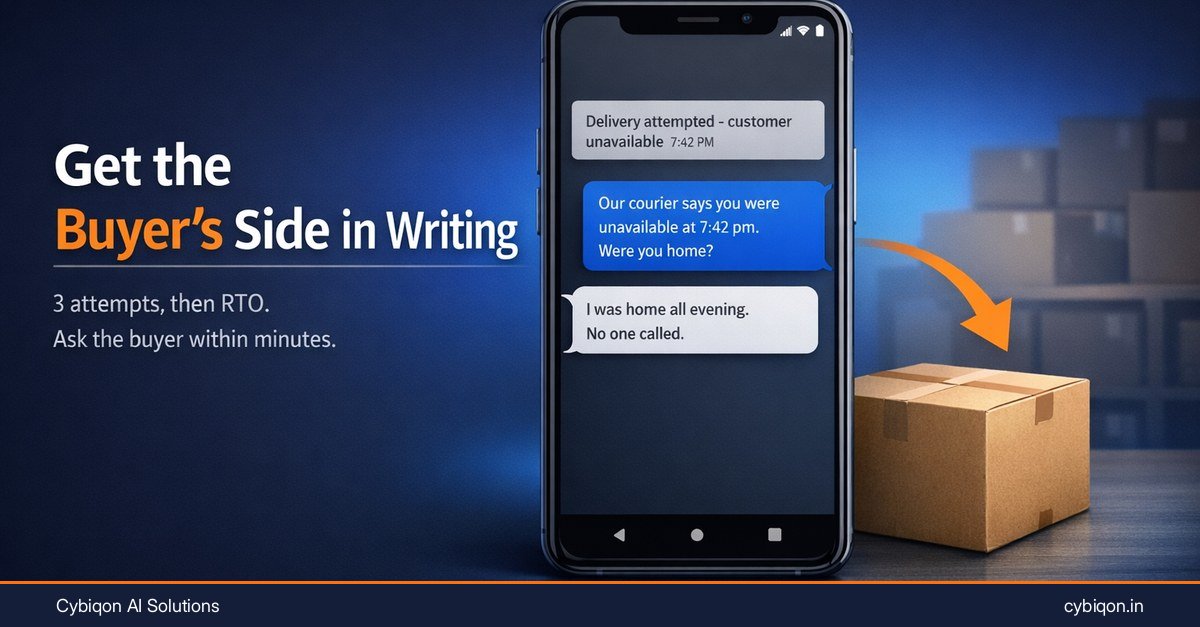
The buyer was at home all evening. The courier app still says "customer not available, 7:42 pm". Your aggregator panel now shows an NDR, and your ops person will call the buyer tomorrow afternoon. By then the parcel may have used a second attempt. A fake delivery attempt is one where the delivery agent marks the order undeliverable without really trying. It quietly turns a COD order into a return you pay for twice.
The numbers are large. Unicommerce's India D2C Report 2026 (410M+ shipments, 6,000+ D2C brands) puts the RTO rate at 39.2% at the November 2025 festive peak. In that festive quarter, 58% of COD orders came back, against under 15% of prepaid. The Amazon Great Indian Festival opens on 8 Oct 2026 and Diwali falls on 8 Nov, so the next peak is close.
This guide explains what NDR means in courier terms, how many attempts you get before RTO, how to use Shiprocket's free fake-attempt escalation, what proof actually wins you, and how to keep your own record of which courier, agent and PIN code causes the problem.
What is a fake delivery attempt? NDR meaning in courier terms
The NDR full form in courier terms is Non-Delivery Report. The courier raises one each time a delivery fails and gives a reason code: customer not available, address incomplete, customer refused, COD amount not ready, and so on. Your aggregator (Shiprocket, Delhivery One and similar) shows it to you as an NDR that needs an action.
A fake delivery attempt is an NDR where the reason is not true. The agent never reached the door, never called, or called once from a number that never rang. Then they logged "customer not available" or "customer refused" to close the stop. That is how a "customer not available" fake delivery NDR gets created. The pressures behind it are easy to see: too many stops on a route, an evening cut-off, a COD parcel in an area the agent would rather not go to. Inc42's "The Festive Delivery Squeeze" (1 Sep 2026) expects a 10–15% shortfall in peak frontline logistics roles this season, even with temporary hiring up 15–20%.
How common is it? The only figure available is Shiprocket's own July 2024 estimate that about 15% of failed deliveries are fake attempts. That is a single vendor source and should be read as one. Buyers notice it too. "Delivery attempt failed but no one came" is a common complaint. The National Consumer Helpline logged 79,818 non-delivery complaints in 2025, the largest e-commerce category (Lok Sabha reply, via Inc42). That figure covers every kind of non-delivery, not only fake attempts.
The real difficulty is that you only see the courier's side of the story. A fake NDR from a courier looks exactly like a real one: a status code and a timestamp, with no call log and no GPS pin.
How many delivery attempts before RTO — and the 24-hour clock
This is the part most sellers get wrong, because the rules differ between aggregators. Here is what is published:
| Shiprocket | Delhivery One | |
|---|---|---|
| Attempts before RTO | 3, then RTO | Up to 3 reattempts; a failed 3rd attempt is auto-RTO |
| Seller action window | Act within 24 hours of the NDR | Act from the NDR panel or API |
| If you do nothing | Shiprocket asks the courier for a reattempt on your behalf | The shipment moves towards the next attempt or RTO |
| Fake-attempt escalation | Built-in "Fake Attempt" action with audio or screenshot proof | No "fake attempt" action in the documented API |
| Escalations | Up to 6 escalations/re-escalations per NDR | Bulk NDR actions for up to 5,000 AWBs |
| Buyer calling | IVR on Advanced/Pro plans only | IVR can be re-triggered only on refused shipments |
These rules are verified for Shiprocket and Delhivery One only. Shadowfax, Xpressbees and the other couriers may work differently, so check your own contract before assuming three attempts. Ecom Express is now part of Delhivery (CCI approval 17 Jun 2025, closed July 2025).
Missing Shiprocket's 24-hour window does not trigger an RTO immediately. What it does is leave the decision with the courier, and the automatic reattempt uses up one of your three attempts with no new slot, no corrected landmark and no proof attached. The same agent, same address and no new information rarely gives a different result.
Speed matters beyond that. Shipway's ShipNotes data (single source) puts RTO at 22% when the order is attempted within 1–2 days, 27% at 3–5 days and 35% at 5+ days. The same data shows about 26% of COD orders going RTO against under 2% of prepaid in FY25, ranging from 18% in Vadodara to 35% in Patna. NDR management is mainly about how fast you respond.
Why agents mark "customer not available" without visiting
You cannot see the agent's route, but you can see patterns in your own NDR export. Watch for these warning signs (iCarry's February 2026 list matches most of them):
- The same agent keeps marking "unavailable" across different buyers and days
- Attempts logged late in the evening or at odd hours, such as 9:50 pm in a residential area
- Several NDRs with the exact same timestamp, which suggests they were marked in bulk rather than at each door
- No missed call on the buyer's phone when the reason says "not reachable"
- NDRs concentrated on one PIN code or one delivery centre
One of these can be chance; several on the same lane, week after week, is a pattern. You only see it if someone records the buyer's side of each NDR.
How to prove a fake delivery attempt on Shiprocket (the free route)
Use the free option first. If you ship through Shiprocket, you already have a fake-attempt flow and pay nothing extra for it:
- Open the NDR within 24 hours. In the NDR panel, choose the action for the shipment rather than letting it lapse.
- Contact the buyer quickly and ask plainly: were you available at the time the courier recorded? Did anyone call?
- Collect proof. Shiprocket's "Fake Attempt" action accepts audio or a screenshot of the buyer confirming they want a reattempt. A call recording or a WhatsApp reply works if it is clear and has a timestamp.
- Raise the reattempt as a fake attempt with the proof attached, plus a corrected phone number, landmark or preferred slot if you have one.
- Escalate again if it fails again. Each NDR can be escalated or re-escalated up to 6 times. Use them, especially on high-value COD orders.
On Delhivery One, the documented NDR actions are reattempt, defer delivery (up to 6 days) and edit details (address or phone). There is no separate "fake attempt" action, so the buyer's evidence goes into a support escalation.
What proof wins — and whether RTO charges get refunded
It is better to be honest about this now than to be disappointed later. No aggregator publicly promises to reverse RTO or forward charges, or to penalise the courier, when a fake attempt is proven. What the evidence reliably gets you is:
- A reattempt with your proof and corrected details attached, instead of a blind retry
- A record you can raise in your account manager review
- Data for courier allocation: which courier should handle which PIN codes
A refund of RTO charges is not guaranteed and should not be your reason for doing this. The real gain is converting the order the second time and changing courier allocation so the same lane does not fail again next month.
The evidence is also useful after an RTO. If a parcel still comes back, you want its history on file when you check what "RTO QC passed" really tells you about the returned item. It is the same habit that helps sellers dispute courier weight discrepancy charges: timestamped evidence you hold yourself wins more arguments than a complaint written from memory.
NDR management with your own data: the courier × agent × PIN log
Aggregator dashboards show NDR counts. They rarely tell you that one courier, one agent and one PIN code account for most of your "customer unavailable" NDRs, or that the buyer said "no one came" on most of them.
To see that, keep a simple log with one row per NDR:
| Field | Why it matters |
|---|---|
| AWB, order ID, COD/prepaid, order value | Prioritise high-value COD |
| Courier, delivery centre, agent name/ID (if shown) | Find the repeat offender |
| PIN code | Allocation decisions |
| NDR reason and courier timestamp | Spot odd-hour and bulk-marked attempts |
| Buyer's reply and its timestamp | Your side of the story |
| Action taken, when, attempt number | Did you act inside 24h? |
| Final outcome (delivered / RTO) | Which lanes actually recover |
Kept for a month, this log tells you which couriers to move, which PIN codes to switch to prepaid-only or partial COD, and which escalations deserve to go to your account manager. It sits inside the wider playbook to reduce your RTO rate, alongside address checks and COD confirmation, and it is the part aggregators do not do for you.
Automating fake delivery attempt checks on WhatsApp
This section is an illustration, not a case study. Say a COD-heavy D2C brand ships about 400 orders a day through Shiprocket across three or four couriers. NDRs are exported to a Google Sheet once a day and the team calls buyers by hand. Buyers who say "no one came" are never written down, reattempts go out a day late, some parcels use all three attempts, and RTO charges are paid without question. Nobody can say which courier, agent or PIN code causes the "customer unavailable" NDRs.
Here is what WhatsApp NDR automation looks like in that setup, including a Shiprocket fake attempt escalation that goes out without anyone typing it:
- The NDR arrives through the aggregator's webhook or API.
- Within minutes, a WhatsApp utility message goes to the buyer in Hindi or English: "Our courier says you were unavailable at 7:42 pm. Were you home?" with reply buttons for "I was home", "Reschedule" and "Change address".
- The reply is saved with its timestamp, and becomes the screenshot or proof for the fake-attempt action.
- The reattempt is pushed inside the 24-hour window, through Shiprocket's NDR action or Delhivery's documented
/api/p/updateendpoint (RE-ATTEMPT, DEFER_DLV up to 6 days, EDIT_DETAILS). The Shiprocket endpoint names in circulation come from unofficial third-party SDKs, so check them against apidocs.shiprocket.in before building on them. - Every row goes into the courier × agent × PIN log.
What does it cost to run? A WhatsApp utility template in India costs about ₹0.115 per delivered message in Meta fees. From 1 Oct 2026, utility templates sent inside the 24-hour customer window are also charged, and free-form service replies are charged after 1,000 free per number per month. At 1,000 NDRs a month and two messages each, that is roughly ₹230 a month before your BSP's markup.
Two safety rules. Send only from a verified business number, and never ask the buyer for an OTP or to click a link in these messages. Delhivery has warned buyers about phishing SMS pretending to be "failed delivery attempt" notices, so a message that asks for either will look exactly like the scam.
Before the October–November 2026 sales
Amazon's Great Indian Festival starts on 8 Oct 2026, Flipkart's Big Billion Days early access opens on 8 Oct (secondary sources put the main sale at 9 Oct), and Diwali is on 8 Nov. Couriers will be short of staff, and overloaded routes are exactly the pressure behind fake attempts. Before then:
- Export the last 60 days of NDRs and sort them by courier and PIN code
- Decide who handles the NDR panel every day, weekends included
- Put a buyer-confirmation step on COD orders (and check whether your COD fee is legal before you use one to push prepaid)
- Move your worst PIN codes to a different courier or to prepaid-only for the sale weeks
FAQs
What is a fake delivery attempt?
It is when a delivery agent records a failed delivery (usually "customer not available" or "customer refused") without really attempting it: no visit, no genuine call. It creates an NDR and uses up one of the limited attempts before the parcel goes RTO.
What does NDR mean in courier and what is the full form?
NDR stands for Non-Delivery Report. The courier raises one each time a delivery fails, with a reason code, and your aggregator asks you to act on it: reattempt, reschedule, change details, or return.
How many delivery attempts does a courier make before RTO?
On Shiprocket and Delhivery One, three. After the third failed attempt the shipment goes RTO. Other couriers may differ, so check your contract.
How do I prove a courier's delivery attempt was fake?
Get the buyer's account quickly and with a timestamp: a call recording or a WhatsApp reply saying they were available and nobody came or called. On Shiprocket, attach it as audio or a screenshot through the Fake Attempt NDR action within 24 hours, and re-escalate (up to 6 times) if needed.
Can I get RTO charges refunded if the delivery attempt was fake?
No aggregator publicly guarantees it. Proof mainly wins you a reattempt and gives you data for courier allocation. Do not plan on getting a refund.
Want this built for your NDR volume?
If you already work the Shiprocket or Delhivery NDR panel every day and it is mostly working, stay with it. It is free. If NDRs arrive faster than your team can call buyers, Cybiqon can build an owned WhatsApp NDR agent. It messages the buyer from your verified number within minutes, saves the timestamped reply as fake-attempt proof, pushes the reattempt through the aggregator's API inside the window, and keeps the courier × agent × PIN log. It runs alongside your aggregator rather than replacing it. We write it for your couriers and your workflow, not from a template, and you own the code and the log.
Email your monthly NDR count and courier mix to [email protected], and we'll tell you honestly whether the aggregator's panel is enough or whether an owned agent pays for itself before Diwali. Or book a 30-minute call or ring +91 9250711473.
Conclusion
A fake delivery attempt uses up one of your three attempts, and it is hardest to fight when all you have is the courier's status code. Act on every NDR within 24 hours, use Shiprocket's free Fake Attempt escalation with proof, and do not count on a refund. The lasting value of the evidence is knowing which courier, agent and PIN code to drop before 8 Oct. If doing this by hand no longer keeps up, Cybiqon can build the agent that does it for you.
Want this set up for your business?
Book a free call — no tech jargon, no sales pressure. Just honest answers.