extracting business data from Google Maps to build retailer lists for new districts, within Google's terms and DPDP
Extract Business Data from Google Maps: The Right Way in India
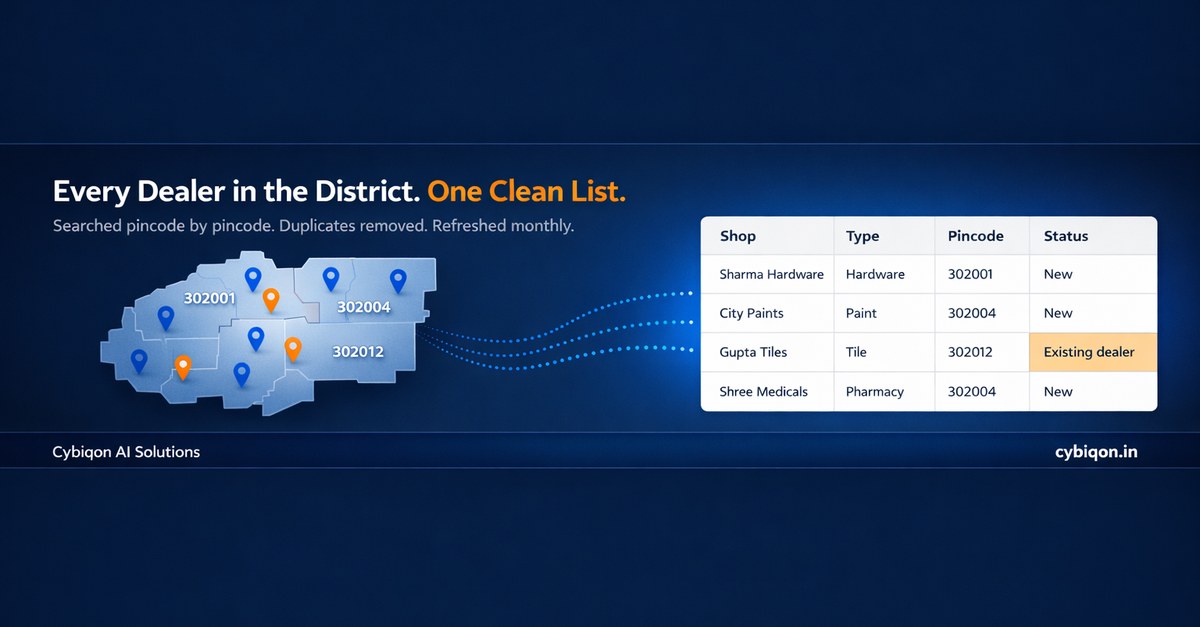
Extract Business Data from Google Maps: The Right Way in India
Your salesman has spent three days in a new district copying tile dealers off Google Maps into his own Excel sheet. Half the rows are the same shop spelled three ways. Two are your existing dealers. And the ₹1,499 "Google Map Extractor" someone bought on IndiaMART has started returning CAPTCHAs and blank columns.
If you want to extract business data from Google Maps for territory mapping, there is a better route, and it is close to free. On India pricing, Google's Places API gives you 7,000 free lookups a month of the kind that return a shop's phone number and website, against 1,000 globally. The search that finds the shops in the first place costs nothing at any volume.
This guide is for owners and sales heads of paint, tile, electricals, FMCG and pharma companies moving into new districts. It covers what Google's terms actually say, India API pricing, the 60-result ceiling, a cost estimate for one district, and the DPDP and TRAI rules that apply once your team starts calling.
Why distributors want to extract business data from Google Maps now
According to NIQ's India FMCG Snapshot of 13 March 2026, rural FMCG volume growth has beaten urban for eight quarters in a row (2.9% against 2.3% in October–December 2025). That pulls distributors into districts where nobody on the team knows the market.
The numbers are large. AIOCD states a membership of 12.4 lakh chemists, pharmacists and distributors, and a pharma distributor finds its share one district at a time.
Say a tiles manufacturer opens three new districts in Madhya Pradesh. This is an illustration, not a client story. The usual sequence goes like this:
- Salesmen copy names and numbers from Google Maps and JustDial into personal sheets that never get merged.
- Existing dealers get cold-called as prospects.
- The cheap extractor works for two weeks, then breaks after a Maps change.
- Someone buys a stale "1.79 lakh retailer" Excel database with no record of where the numbers came from.
The hard part is not getting data out of Google Maps. It is a list you can trust, refresh monthly and keep without breaching anything. Google Maps is only one source for this kind of work, and our guide to market research with web scraping and AI automation covers the others.
Is it legal to extract data from Google Maps in India?
We are not lawyers. For large-scale use, get legal advice. What follows is what the documents actually say.
Google's contract is clear. Section 3.2.3 of the Google Maps Platform Terms of Service says: "Customer will not export, extract, or otherwise scrape Google Maps Content for use outside the Services." The examples Google gives include bulk downloading places information, and to "copy and save business names, addresses, or user reviews." Data you get through the paid API is still Google Maps Content. Paying for it does not make it yours to keep.
The storage rules are narrow. Google's Places API policies say you must not pre-fetch, cache or store Places content, apart from specific exceptions. The Service Specific Terms (Places section) allow two:
- place_id (Google's unique ID for a listing) can be stored indefinitely.
- Latitude and longitude can be cached for up to 30 consecutive calendar days and must then be deleted.
A permanent spreadsheet of Google-sourced names and phone numbers therefore does not fit the terms. The pattern that does fit is to store place_ids, fetch the details live when you build a call sheet, and keep long term only what your own team verifies.
Google's end-user Maps terms, which cover the website itself, also prohibit mass downloading or creating bulk feeds of Maps content.
What about the SerpApi ruling? Tool sellers quote it as proof that "scraping Google is legal". On 20 July 2026 a US federal judge (N.D. Cal.) dismissed Google's DMCA claims against SerpApi, and Google filed a narrower amended complaint on 10 August. That case is about US copyright law and Google Search, and the Maps theory was dropped. It says nothing about Google's contract terms or India's data law. For the wider picture, read our explainer on whether web scraping is legal in India.
Why Google Maps extractor tools and Chrome extensions stop working
Every Google Maps scraper that reads the Maps website depends on Google not changing the site or noticing the tool. Neither lasts.
- February 2026, "limited view". Google Maps briefly showed signed-out users a limited view that hid reviews, photos and some listings. Google cited "unusual traffic" and interfering extensions. It was later reverted, but in the meantime it broke many extractors that ran without a login.
- The sellers say so themselves. The ₹1,499 Google Map Extractor listed on IndiaMART by an Indore seller notes that it "may require proxies or other tools to avoid being detected as a bot" and "should comply with Google's Terms of Service." If a tool needs proxies to avoid detection, its seller expects it to be blocked.
- Fake and dead listings come along too. Google removed 13 million fake Business Profiles in 2025 (over 12 million in 2024), so any Maps list holds fakes, duplicates and closed shops unless you filter them.
Cybiqon publishes a free Chrome extension, MapWit, which reads one search you run in your own browser, at a human pace, and stops at a CAPTCHA. It is useful for sizing up a search, not for mapping every pincode in a district monthly, and its documentation says the same Google terms and DPDP rules apply to what you export. We cover the wider extension market, and what Chrome and LinkedIn now ban, in our guide to Chrome extensions for verified Indian business contacts.
Google Places API India pricing and the 2026 free limits
Here is the part most Google Maps data extractor vendors leave out.
India pricing has applied since 1 August 2024. On 1 March 2025, Google replaced the old $200 monthly credit with a free monthly cap for each SKU (each separately billed type of call). The India caps are seven times the global ones:
| Tier | Free calls per month (India) | Free calls per month (global) | Example India price per 1,000 after the cap |
|---|---|---|---|
| Essentials | 70,000 | 10,000 | — |
| Pro | 35,000 | 5,000 | Text Search Pro: $9.60 (global $32) |
| Enterprise | 7,000 | 1,000 | Place Details Enterprise: $6.00 (global $20); Text Search Enterprise: $10.50 (global $35) |
| Text Search Essentials (IDs Only) | Free, unlimited | Free, unlimited | $0 |
Which fields sit in which tier (from Google's Place Data Fields page):
- IDs Only (free):
places.id, the place_id and nothing else. - Pro: name, address, place type, location.
- Enterprise: phone number, website, opening hours, rating.
So yes, the Places API returns business phone numbers. That is the Enterprise tier, and on India pricing the first 7,000 of those calls each month are free.
The eligibility caveat. India pricing requires "billing and a large majority of usage in India". India-pricing accounts cannot join Google's subscription plans, and prices are in USD. You need a billing account even to use the free caps.
One more trap: a request is billed at the highest SKU of any field you ask for. Ask Text Search for phone numbers and every page is billed at the Enterprise rate. The design below avoids that.
Why Google Maps only shows 60 results, and how to get every shop
Search "hardware shops in Indore" and you will never see the whole town. That is by design:
- Text Search (New) returns at most 20 places per page and at most 60 across all pages. Google notes this limit may change.
- Nearby Search (New) returns at most 20, with no further pages, within a radius of up to 50 km.
The answer is to make each search narrow. Build a retailer database by pincode: one search per pincode per category, then merge the results.
Categories need care. Google's place types include hardware_store, pharmacy, drugstore, home_improvement_store, electronics_store, wholesaler and building_materials_store. There is no tile store or paint store type, so tile and paint dealers need text queries such as "tile dealer 452001" or "paint shop 452001". If a search still returns the full 60, split it further by locality, because you are probably missing shops.
A worked cost estimate for one district
This is an estimate, not a measurement. The assumptions are stated so you can swap in your own numbers. The prices are Google's published India per-1,000 rates and free caps from the table above.
Assume one district with 40 pincodes and 5 categories (hardware, building materials, electricals, "tile dealer", "paint shop"):
- Discovery: 40 × 5 = 200 searches. With up to 3 pages each, that is at most 600 requests, all with the IDs-Only field mask. Cost: $0. This SKU is free and unlimited.
- Dedupe: merge by place_id. Assume that leaves about 2,000 unique shops, of which about 150 are already your dealers. Match their place_ids once and flag them.
- Details for new shops: about 1,850 Place Details Enterprise calls for phone, website, hours and business status. That is inside the 7,000 free Enterprise calls. Cost: $0.
- Monthly refresh: Google's details are fetched live, not stored, so you repeat step 3 each month. Three districts at this size come to about 5,550 calls, which is still under the cap.
Scale to ten similar districts and you reach about 18,500 Enterprise calls a month. Minus the 7,000 free calls, 11,500 at $6.00 per 1,000 comes to about $69 a month.
Drop any shop whose businessStatus is not OPERATIONAL; a salesman's call or visit stays the final check.
How to extract business data from Google Maps to Excel without breaking the terms
The dealer list from Google Maps your team needs is a monthly call sheet built from live data, plus a growing file of records your team collected itself. The pipeline looks like this:
- Search by pincode × category with the IDs-Only mask (free).
- Dedupe on place_id, which you are allowed to store.
- Flag place_ids already linked to your dealer master, so no dealer gets a prospecting call.
- Fetch details live for new shops only, and drop closed ones.
- Deliver a call sheet in Excel or a CRM import to each salesman for his beat.
- Replace Google data with your own. When a salesman calls or visits, he records the owner's name, checks the GSTIN on the GST portal and records consent to contact. That record belongs to your company and can be kept.
GST search is for verifying shops, not finding them. The GST portal's Search Taxpayer tool (by GSTIN or PAN, behind a captcha) returns legal and trade name, registration status and principal place of business. It confirms a shop is real. It cannot list shops in a pincode.
Udyam had crossed 8.9 crore registrations by 14 July 2026 (PIB) but has no public contact directory. IndiaMART's Terms of Use prohibit systematic retrieval to compile a database, by robots, spiders, or automatic or manual means.
Only shops with a Google Business Profile reach this pipeline, and why some shops show up on Google and others don't is a local-SEO story of its own. Your salesmen's field notes fill that gap.
DPDP and TRAI: what applies before your team starts calling
DPDP. The Digital Personal Data Protection Rules were notified on 14 November 2025 with an 18-month phase-in. Consent-manager provisions start in November 2026, and most obligations on businesses apply from 13 May 2027. On 31 August 2026, MeitY Secretary S. Krishnan said the notified deadlines stand (VARINDIA).
A sole proprietor's mobile is personal data. Section 3(c)(ii) excludes data "made or caused to be made publicly available by the Data Principal" (or by someone legally obliged to publish it), which is narrower than "findable online" (India Briefing, 10 September 2026). An owner-created listing may qualify; user-suggested or Google-generated ones may not. Record each number's source and collect consent at first contact.
TRAI. TRAI amended the TCCCPR 2018 rules on 12 February 2025. Action now starts at 5 complaints in 10 days, down from 10 in 7. Promotional calls must come from 140-series numbers and service or transactional calls from the 1600 series. Repeat violations risk disconnection and blacklisting, which is the exposure when salesmen cold-call hundreds of shops from personal mobiles.
FAQs
Is it legal to extract data from Google Maps in India?
Scraping Maps or bulk-saving Places data breaches Google's terms (section 3.2.3). The official Places API is allowed, but only place_ids may be kept indefinitely and coordinates for 30 days. DPDP applies to proprietors' mobiles. We are not lawyers; take legal advice for large-scale use.
Why does Google Maps only show 20 or 60 results, and how do I get all shops in a city?
Text Search returns at most 20 per page and 60 in total, and Nearby Search returns 20. To cover a city, search pincode by pincode and category by category, then dedupe the results on place_id.
Can I use the Google Places API to get business phone numbers, and what does it cost in India?
Yes. Phone number is an Enterprise-tier field. India pricing gives 7,000 free Enterprise calls a month, and after that Place Details Enterprise costs $6.00 per 1,000. You need a billing account, and India pricing requires most of your billing and usage to be in India.
How many free Google Maps API calls do I get per month after the March 2025 change?
Each SKU has its own cap. On India pricing it is 70,000 Essentials, 35,000 Pro and 7,000 Enterprise calls a month. Text Search IDs Only is free and unlimited.
What Cybiqon would build for your territory
Cybiqon would build your own Places API pipeline. It searches every pincode and category in the districts you name, dedupes on place_id, flags shops already in your dealer network, drops closed listings and delivers a fresh call sheet or CRM file per salesman each month. It keeps only what Google's terms allow plus your team's verified records, and runs on your own Google billing account at India pricing.
It is written for your territories and your dealer master, not configured from a template, and you own the code. See our web scraping and data extraction service, or book a 30-minute call. You can also reach us on +91 9250711473 or at [email protected].
Conclusion
You can extract business data from Google Maps for a whole district without a ₹1,499 tool that breaks. Search pincode by pincode with the free IDs-Only search, dedupe on place_id and flag existing dealers. Fetch phone numbers live within India's 7,000 free Enterprise calls, and let every salesman's call turn a Google listing into a record your company owns. Handle consent from the first call, well before DPDP's May 2027 obligations apply. If you would rather have this built than run it on spreadsheets, Cybiqon is a 30-minute call away.
Want this set up for your business?
Book a free call — no tech jargon, no sales pressure. Just honest answers.