AI agent that turns WhatsApp, voice-note, photo and PDF dealer orders into draft Tally sales orders for distributors
AI Agent for Order Processing India: WhatsApp to Tally, Safely
AI Agent for Order Processing India: WhatsApp to Tally, Safely
"Parle-G 5 wala 10 peti bhej do. Maggi 12 ka 4 carton." If your Monday morning looks like that, most of what you find when you search for an AI agent for order processing in India was written for someone else. Page one is Microsoft and SAP partners turning emailed purchase orders into ERP entries, or app vendors who want your dealers to download something. Most purchase order automation in India assumes a clean PDF and an ERP.
This guide is for the other reader: a distributor or wholesaler taking dozens to a few hundred dealer and retailer orders a day as WhatsApp texts, voice notes, photos of handwritten parchis and the odd emailed PO. Someone in your office retypes every one into TallyPrime or a shared sheet, then rings the godown to check stock before replying.
Below: what an order agent does with those messages, how accurate AI is on Hindi voice notes and parchi photos, how it connects to Tally, what WhatsApp's 1 Oct 2026 billing change costs, what it must never be trusted with, and when a dealer portal is the better build.
What an AI agent for order processing actually does
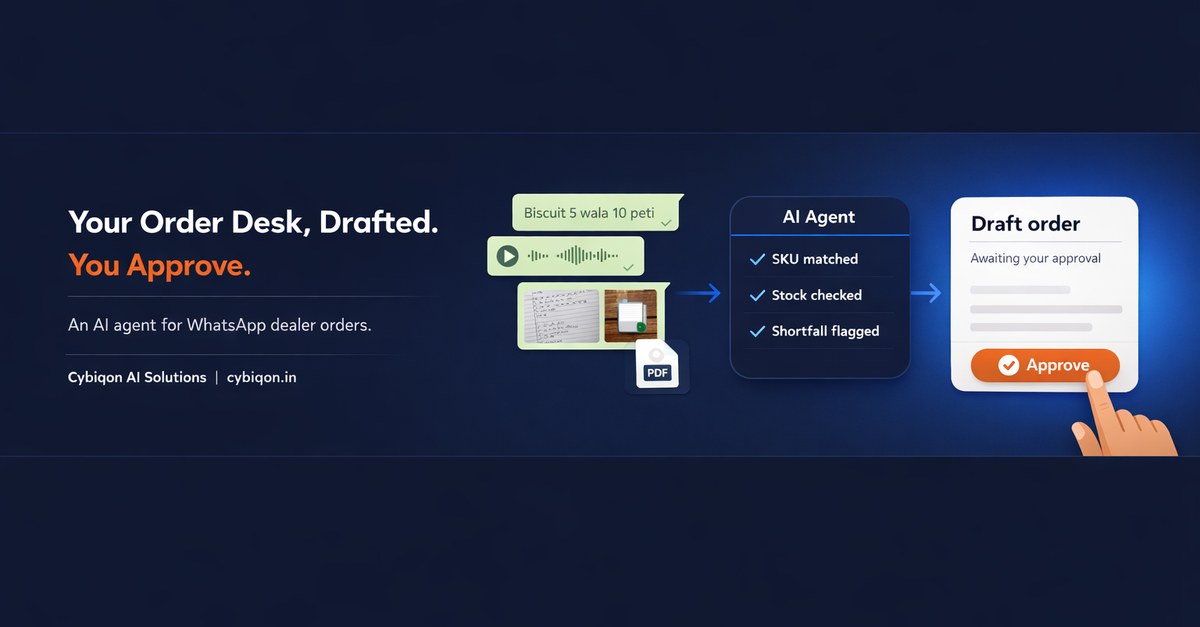
Good WhatsApp order automation for distributors sits on the channels your dealers already use, WhatsApp and email, and does the typing your office does today. The dealer changes nothing. AI order entry for distributors comes down to five jobs:
- Read the order in whatever form it arrives. A Hinglish or Marathi text, a 40-second voice note, a photo of a handwritten list, a PDF attached to an email. It should also automate order entry from email PDF POs, which modern-trade buyers still send.
- Match dealer words to your SKU codes. "Parle-G 5 wala" is the ₹5 pack; "peti" is a case. The agent learns this from an alias table built from each dealer's past orders, so one retailer's "chhota Surf" and another's "Surf 500" land on the same code.
- Check stock in TallyPrime or your stock sheet.
- Flag shortfalls. You have 6 cartons, the dealer wants 10: it says so and suggests what is available. It never quietly substitutes.
- Draft the Sales Order and the reply, and hold both until someone in your office releases them.
Every step is logged with the original attached, so when a dealer says "maine 12 bola tha", you can play back what arrived. Your staff go from typing to checking.
India has roughly 4 lakh FMCG and consumer-products distributors, according to the All India Consumer Products Distributors Federation (via MediaNama, March 2025), and Meta's newsroom (14 May 2026) cited Kantar research finding 91% of online adults in India chat with a business every week.
Can AI understand Hindi voice notes and handwritten parchis?
The best evidence is the Voice of India benchmark from AI4Bharat at IIT Madras with Josh Talks (arXiv, April 2026, revised July 2026). It tested 14 speech-recognition systems on 536 hours of real, unscripted Indian telephone speech from 36,691 speakers in 15 languages. Hindi word error rates:
- Sarvam Audio: 5.0%
- Google Gemini 3 Flash: 8.3%
- OpenAI GPT-4o Transcribe: 33.9%
Same audio, a nearly sevenfold gap. Telugu was harder: the best system managed 18.2%, Gemini 3 Flash 27.9%. The authors note most models exceed a 20% error rate, "a threshold often associated with practical usability", and "no system meets this criterion consistently across all languages." Business Standard reported the same pattern in February 2026.
Two caveats: it used phone calls, not WhatsApp voice notes from a noisy godown, and it doesn't score numbers and product names separately, the very words that decide a dispatch.
Photos are similar. A June 2026 study, "Can OCR-VLMs Read Devanagari?" (arXiv 2606.29213), found all ten systems scored 91–98 on clean synthetic text, but on 300 real printed scans Gemini 2.5 Flash scored 86.3, Claude Opus 4.7 82.2 and GPT-5.5 58.5 (chrF++). Its verdict: "strong English OCR does not predict Indic OCR." Handwriting wasn't tested, and separate research (Crosilla et al., arXiv 2503.15195) found multimodal models weaker on non-English handwriting and poor at correcting themselves.
So turning a handwritten order into a sales order with AI, or a WhatsApp voice note order into Tally, needs two design rules:
- Choose the speech model per language, and test it on your own dealers' voice notes before going live.
- Score every line. Tamil or Telugu voice notes, noisy recordings, smudged parchis, unknown aliases and odd quantities go to a person with the original audio or photo attached.
WhatsApp order to Tally: how the agent talks to TallyPrime
You don't need to replace Tally for any of this. The sensible design is to keep Tally as the ledger and build on top of it, and TallyPrime now makes that easier.
- XML over HTTP. TallyPrime can run as a local HTTP server on port 9000 by default (enable it under F1 > Settings > Advanced Configuration). Software on your network can then request the stock summary or push a voucher. Tally has to be running.
- Native JSON since TallyPrime 7.0. The 19 December 2025 release added JSON import and export, including a "JSONEx" format, without writing TDL (Tally's customisation language). A TallyPrime JSON API integration can exchange masters, vouchers and reports over HTTP. Release 7.1 (20 May 2026) didn't change this.
Through that interface the agent reads closing stock for the ordered items and pushes a Sales Order voucher. That choice is the safety net in sales order automation for TallyPrime. A Sales Order is an order-tracking voucher: it records what was asked for and what is pending, but it isn't a sales invoice. If the agent gets a line wrong, your staff edit a draft order, not a tax document.
Note that Tally's own WhatsApp add-on (₹1,300 a year plus GST) sends invoices and reports out and manages an inbox. It doesn't capture incoming orders, and neither do most "Tally WhatsApp" plugins.
If your stock lives in Google Sheets or Excel, the same agent reads and writes the sheet. The rule stays the same: draft first, a person releases.
What an AI order agent should never be trusted with
Even Microsoft's generally available Sales Order Agent in Dynamics 365 Business Central doesn't run unsupervised. Per Microsoft's documentation (updated 2 Sep 2026), it always creates a sales quote first, "a safe intermediate document for AI-assisted processing", and "always involves designated Business Central users to review and approve all outgoing messages." It identifies customers only by exact email match, is capped at 100 emails a day by default, and Hindi isn't on its validated language list. If Microsoft keeps a human in the loop for English emails, Hinglish voice notes deserve at least that.
Keep these with people, always:
- Releasing orders over a dealer's credit limit or with overdue bills. The agent flags; accounts decides.
- Price, scheme and discount exceptions. "Last time 2% extra diya tha" is a negotiation, not data entry.
- The tax invoice and e-invoice IRN. An IRN can be cancelled on the portal only within 24 hours and only in full, and the same invoice number can't get a new IRN. After that you need a credit note or a GSTR-1 amendment, and any e-way bill must be cancelled first. E-invoicing is mandatory above ₹5 crore turnover (since 1 Aug 2023), and since 1 Apr 2025 businesses at ₹10 crore and above can't report e-invoices older than 30 days.
- Substituting a product without asking the dealer.
- Delivery dates the godown hasn't committed to.
- Anything low-confidence, which goes straight to the human queue.
WhatsApp Business API pricing in India from October 2026, and the AI rules
Two policy changes shape the build.
Billing. From 1 October 2026, per Meta's pricing page (Sep 2026), free-form replies through the WhatsApp Business Platform are billed at the utility rate: ₹0.115 per message in India plus 18% GST, after the first 1,000 service messages per business phone number each month, with no rollover. Utility templates inside the service window stop being free too. Replies within the 72-hour window opened by a Click-to-WhatsApp ad stay free, and the free WhatsApp Business app is unaffected.
AI terms. Since 15 January 2026, WhatsApp's Business Solution Terms bar "AI Providers" where AI is "the primary (rather than incidental or ancillary) functionality". An agent that takes orders for your distributorship, where AI is incidental to a business task, is allowed; a general-purpose chatbot is not. The terms also bar using business chat data to "create, develop, train, or improve" AI models, so your dealers' messages can't be used for training.
The platform. Automating the free Business app with unofficial tools breaks WhatsApp's messaging guidelines, so the agent must run on the official Cloud API. If you haven't made that move, here is what the WhatsApp Business API involves. BSPs such as 360dialog document a "Coexistence" setup that keeps the same number usable in the Business app for your staff.
Meta launched Business AI in the WhatsApp Business app in India in May 2026, but its announcement mentions no inventory or Tally connection. That is the gap a custom agent fills.
What an AI agent for order processing costs in India
A hypothetical to make the numbers concrete: say a Nagpur FMCG distributor with about 350 retailer accounts gets 180 orders on a Monday morning: roughly 110 WhatsApp texts in Hinglish and Marathi, 40 voice notes, 20 parchi photos and 10 emailed PDF POs from two modern-trade buyers. Today two office staff retype them into TallyPrime, ring the godown and reply one by one; shortfalls surface at dispatch.
With an agent, each order becomes a draft Sales Order and reply on a review screen. Staff approve or edit, unclear items go to a human queue, and accounts still raises the GST invoice.
Per-order AI cost (our estimate). Assuming about 4,000 input tokens (instructions, dealer profile, ~40 candidate SKUs) and 1,000 output tokens, at ₹95.7 per US dollar (RBI reference rate, 11 Sep 2026) and published API prices:
| Order arrives as | Gemini 2.5 Flash | Claude Haiku 4.5 |
|---|---|---|
| Text message | ≈ ₹0.35 | ≈ ₹0.86 |
| Photo of a parchi | ≈ ₹0.40 | ≈ ₹1.01 |
| 60-second voice note | ≈ ₹0.54 | ≈ ₹1.36 (with Sarvam speech-to-text at ₹0.50/min) |
A second verification pass pushes the worst case to about ₹2.0–₹2.25 an order. Don't choose a cheaper transcription model for Hindi voice notes on price alone; the benchmark above shows why.
Monthly running cost at ~3,500 orders (estimate):
- AI models: 3,500 × ₹0.35–₹2.25 ≈ ₹1,200–₹7,900
- WhatsApp replies: ~3,325 WhatsApp orders × 2 replies = 6,650, minus 1,000 free = 5,650 × ₹0.115 ≈ ₹650, about ₹770 with GST
- Hosting: a small server for the agent and review screen, depending on your setup
Build cost. Cybiqon's AI agents start at ₹19,999 one-time and take 1–3 weeks. Tally integration, voice support across languages and catalogue size all move the scope, which is why it is fixed on a first call rather than guessed here.
AI order agent or B2B ordering app: which should a distributor build first?
The agent works on the channel dealers already use, and the dealer changes nothing. A portal asks the dealer to change how they order, and for some distributors that is the better deal. A B2B ordering app for distributors beats an agent when:
- Dealers reorder the same SKUs week after week; a saved list beats any message.
- Your catalogue is large, or you run tiered dealer pricing and schemes.
- Dealers need to see stock, outstanding and statements themselves.
- Volume is high enough that per-message fees plus review time add up.
- You want zero interpretation error. A form can't be misheard.
For many, the honest answer is both: a portal for the top dealers who will use it, and an agent handling dealer order management on WhatsApp for the long tail who will only ever send voice notes. Either way, both should feed the same stock and the same Tally, as part of one connected system for orders, stock and accounts rather than another island.
And sometimes it's neither. If you take a handful of orders a day, a cleaner order sheet and a WhatsApp catalogue will serve you better than any software.
FAQs
Can AI read handwritten orders sent on WhatsApp?
Often, but not reliably enough to go unchecked. Models read clean printed Indian-language text well, but Devanagari handwriting hasn't been benchmarked, and research finds them weaker on non-English handwriting. Score each line and send unclear parchis to a person with the photo attached.
Can WhatsApp orders be entered into Tally automatically?
Yes, as drafts. An agent can read the message, match it to your stock items, check closing stock in TallyPrime over its HTTP interface (XML, or JSON since TallyPrime 7.0) and create a Sales Order voucher. A person approves it before the dealer gets a confirmation, and accounts raises the invoice separately.
How much does an AI agent for order processing cost in India?
Running costs are small: roughly ₹0.35–₹2.25 per order in AI model fees (estimate), plus WhatsApp reply charges from 1 Oct 2026 of ₹0.115 + GST per message after 1,000 free per number each month. Build cost depends on scope; Cybiqon's AI agents start at ₹19,999 one-time.
Should an AI agent generate GST e-invoices automatically?
No. An e-invoice IRN can be cancelled only within 24 hours and only in full; after that, corrections need credit notes or return amendments. Let the agent draft Sales Orders and keep the tax invoice with your accounts team.
Build it for your order book
Cybiqon's founders would build an order agent on your WhatsApp Business number and order inbox, wired to your TallyPrime or stock sheet. It reads texts, voice notes, parchi photos and PDF POs, maps your dealers' words to your SKUs, checks stock, and drafts each Sales Order and reply for your staff to approve. It is written for your catalogue and your dealers, not configured from a template, and you own every line of the code. See how we build AI agents for order processing, or, if the portal case above sounds like you, dealer portals and admin panels start at ₹29,999 (4–6 weeks).
Not sure which you need? Send one anonymised day of dealer orders to [email protected] and we'll tell you whether it needs an agent, a portal or neither. Or book a 30-minute call, or ring +91 9250711473.
Conclusion
An AI agent for order processing in India earns its keep by doing the typing, not the deciding. Let it read the voice note, match "5 wala" to the right SKU, check Tally and draft the Sales Order. Keep credit, pricing, substitutions and the GST invoice with people. Pick the speech model for your dealers' languages, budget for WhatsApp's charges from 1 Oct 2026, and move repeat dealers to a portal once they're ready. For a straight answer on your own order mix, send us one day of orders.
Want this set up for your business?
Book a free call — no tech jargon, no sales pressure. Just honest answers.